


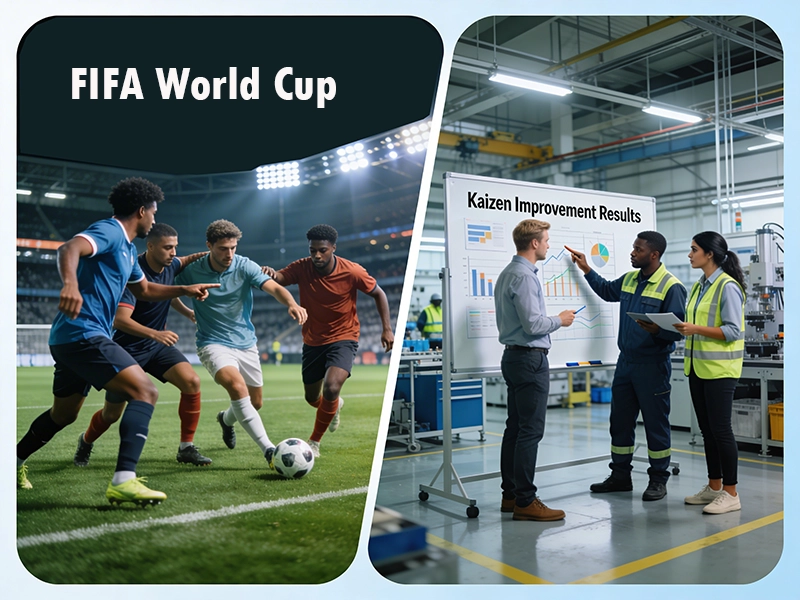
What FIFA World Cup Teams Can Teach Companies About Lean Daily Management

By Tony Rodriguez, President, Daniel Penn Associates
As global attention builds around upcoming FIFA events, business leaders have a timely opportunity to look beyond the excitement of the matches and focus on something more practical:
How elite soccer teams manage performance every day.
The FIFA World Cup 2026 will be the first men’s World Cup to feature 48 teams and three host countries: Canada, Mexico, and the United States. FIFA has also positioned the FIFA Women’s World Cup 2027 in Brazil as the tournament’s 10th edition and the first to be held in South America. These are not just major sporting events. They are large-scale, high-pressure performance systems that depend on preparation, discipline, role clarity, and constant adjustment.
This is where a comparison to lean daily management becomes useful.
At Daniel Penn Associates, we emphasize lean and continuous improvement with our clients. This means listening closely to employees, improving workflow, eliminating waste, and helping teams own better processes. In practice, lean daily management gives organizations a structured rhythm for tracking performance, solving problems, and aligning people around what matters most.
Soccer’s best teams do the same thing.
Why FIFA tournament preparation looks a lot like lean daily management
Big tournaments are won long before kickoff. Coaches, analysts, medical staff, and players prepare through disciplined routines, review, and structured communication. That same logic drives lean daily management in corporations.
The bigger and more complex the environment, the more important daily management becomes. The 2026 FIFA World Cup will expand to 48 teams and 104 matches, which increases the need for coordination, role clarity, and real-time adaptation.
Companies face a similar challenge. As operations become more complex, leaders cannot rely on informal communication or heroic effort. They need a repeatable system that helps teams identify issues early, respond quickly, and stay aligned.
Daily alignment matters more than occasional motivation
Top soccer teams do not rely on inspiration alone. They use daily training sessions, tactical briefings, match preparation, and recovery reviews to stay aligned.
Corporations need the same cadence. Lean daily management works because it creates a routine for reviewing priorities, spotting gaps, and clarifying who is doing what today. When teams huddle regularly and focus on what is off track, they are better prepared to act with speed and consistency.
In soccer, that may mean reviewing opponent tendencies, starting formations, substitution plans, and set-piece responsibilities. In business, it means reviewing safety, quality, delivery, staffing, service levels, or production barriers before small issues turn into larger failures.
Standard work creates flexibility under pressure
To outsiders, elite soccer can look improvised. In reality, great teams rely on repeated patterns, role discipline, and rehearsed responses. Defensive shape, pressing triggers, transition play, and set pieces all depend on standard work.
Lean daily management works the same way. Clear standards do not slow teams down. They create the foundation that allows people to react faster when conditions change.
That lesson is especially relevant as FIFA builds toward events on a larger scale. Strong teams will showcase how preparation and structure separate them from disorganized teams.
For companies, standard work ensures that when demand spikes or a problem emerges, people do not waste time debating the basics. They already know the process, the handoffs, and the escalation path.
Visual management helps everyone see the game
In soccer, performance is visible. Teams can immediately see field position, pressure, space, tempo, and breakdowns in shape. Coaches and players are constantly reading the game and adjusting to what is happening in front of them.
Lean daily management applies that same principle inside the workplace through visual controls. A strong daily management board makes performance easy to understand. Teams can see whether they are on target, where the breakdown is, and what needs attention now.
The key is visibility. When problems stay hidden, they grow. When they are visible, teams can respond early.
The best teams focus on leading indicators, not just final results
A scoreboard matters, but it does not tell the whole story. Soccer teams also watch the indicators behind the result:
- Possession under pressure
- Successful recoveries
- Quality chances created
- Defensive shape
- Fitness
- Decision-making in key moments
Companies should take the same approach. Lean daily management is most powerful when it tracks the measures that predict performance, not just the ones that summarize it after the fact.
If leaders only look at the month-end score, they are reacting too late. Daily management shifts attention to the factors shaping today’s results right now.
Escalation is a strength, not a weakness
Soccer teams operate in layers. Players execute on the field, but they are supported by coaches, analysts, trainers, medical staff, and operations teams. The larger the event, the more important that support structure becomes.
A 48-team World Cup across three host countries demands coordinated decision-making and disciplined support systems.
Corporations need that same tiered approach. Lean daily management should help teams solve problems at the lowest possible level, while making it easy to escalate issues that need broader support. Escalation is not failure. It is part of a healthy management system.
Coaching beats command-and-control
The strongest soccer teams are not built on constant sideline micromanagement. They are built on coaching, preparation, and decision-making capability. Players are trained to read the situation, communicate, and respond under pressure.
The same is true in business. Lean daily management is not about leaders collecting updates. It is about leaders developing teams that can recognize abnormalities, propose solutions, and improve performance every day.
Organizations become more resilient when they stop depending on one person to direct every move and start building a workforce that can think and act in real-time.
Continuous improvement is how teams stay tournament-ready
No elite team assumes yesterday’s preparation is enough for tomorrow’s match. They review film, assess mistakes, refine tactics, and make adjustments quickly.
Lean organizations do the same. Continuous improvement is not an occasional workshop. It is a daily habit of learning, adjusting, and improving performance at the source. Daniel Penn Associates’ approach emphasizes exactly that: listening, improving flow, removing waste, and helping people own better ways of working.
That mindset is what separates organizations that perform well once from those that sustain performance over time.
What business leaders should take from the upcoming FIFA events
As FIFA builds toward the World Cup 2026, and the Women’s World Cup 2027, one message stands out: winning at a high level depends on disciplined daily execution, not just game-day energy.
For corporations, the takeaway is clear. High performance comes from clear daily priorities, visible performance measures, standard work, rapid problem-solving, strong escalation paths, coaching-based leadership, and continuous improvement.
That is lean daily management.
And whether the setting is a global football tournament or a complex business operation, the principle is the same: The teams that perform best under pressure are usually the ones that prepared best in the ordinary moments.
_______________________________
Tony Rodriguez, President, Daniel Penn Associates
Antonio (Tony) Rodriguez is a certified management consultant at Daniel Penn Associates with over 40 years of experience in promoting collaboration and progressive thinking to drive effective change and organizational transformation. With expertise in facilitation and team development, Lean Six Sigma, lean continuous improvement, reengineering, supply chain optimization, supplier diversity, strategic sourcing, asset management, and productivity improvement, Rodriguez has successfully directed projects for large and medium-sized entities, both public and private, national and international.
_______________________________
For more lean management articles:
- Apply a Lean Lens to Your Production Challenges
- How Lean Practices Mirror Olympic Training
- How to Get the Most Out of Your Company’s Lean Leadership Training
- Lean Management and Continuous Improvement Work
- Lean’s Two Ingredients
How is your organization supporting lean daily management?
Daniel Penn Associates helps organizations strengthen lean daily management, improve workflow visibility, and build a culture of continuous improvement that performs under pressure. Contact DPA to learn how your team can apply operational excellence practices that work in the real world.