


Hospital Maintenance: From Reactive Repair to Reliable Care Environments

By Tony Rodriguez, President, Daniel Penn Associates
Summary points:
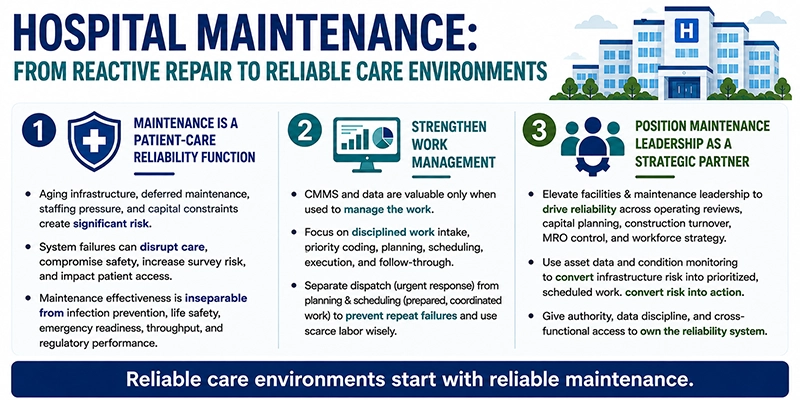
- Hospital maintenance is no longer a back-office service. It is a patient-care reliability function that protects safety, access, compliance, and continuity of operations.
- Aging infrastructure, deferred maintenance, staffing pressure, and capital constraints make the maintenance organization a strategic risk-control function, not simply a repair department.
- CMMS platforms and maintenance data are useful, but the largest improvement opportunity remains disciplined work intake, priority coding, planning, scheduling, execution, and follow-through.
- Reliability-centered maintenance and condition-based monitoring create value only when asset data is converted into prioritized, coded, and scheduled work.
- Administrators should position facilities and maintenance leadership as the driver of maintenance reliability, with a formal role in operating reviews, capital planning, construction turnover, MRO control, and workforce strategy.
What is at stake with hospitals’ maintenance protocols? Reliable care environments
Hospital maintenance organizations must keep aging buildings safe, compliant, energy-efficient, resilient, and continuously available for patient care while competing for capital and technicians. The problem is not effort. It is a strained operating system that rewards urgent response more consistently than failure prevention.
In the 2024 ASHE/HFM Hospital Operations Survey of more than 430 facilities managers and executives, more than half reported responsibility for at least one facility over 50 years old. Eighty percent cited aging facilities and infrastructure as their top concern, and 58% cited a lack of funding, along with staff recruitment and retention, as major challenges. Funding is not keeping pace: 79% said less than half of deferred maintenance requests were funded, while 64% said staffing needs had increased over three years but only 27% had seen maintenance staffing increase.
Health Facilities Management reported in 2025 that national benchmark data showed roughly 53% of major acute and non-acute health care infrastructure assets and systems have exceeded expected useful life, including HVAC, medical gas, electrical distribution, and life safety systems. These systems are the physical platform for clinical care. When they fail, operating rooms can close, patient rooms can be taken offline, emergency power can be compromised, sterile processing can be disrupted, and survey risk can rise quickly.
In an environment of competing demands, maintenance reliability should be an administrative priority for health care systems.
Maintenance effectiveness is inseparable from infection prevention, life safety, emergency readiness, patient throughput, staff productivity, and regulatory performance. The Joint Commission’s EC.02.05.01 standard requires hospitals to manage risks associated with utility systems, including utility design and installation, emergency shutdown labeling, and air pressure, filtration, and air changes in critical care areas. Administrators should view the maintenance organization as a reliability partner to clinical operations, not only as a cost center.
That shift changes the management question. Instead of asking only how quickly maintenance responds, leaders should ask whether the organization is preventing avoidable disruptions, reducing repeat failures, using scarce labor wisely, and translating infrastructure risk into clear operational decisions. The maintenance organization should own the reliability system, while hospital leadership gives it the authority, data discipline, and cross-functional access required to perform that role.
Strengthen work management before adding complexity
Many hospitals have moved beyond paper systems. ASHE/HFM found that 80% of survey respondents have adopted CMMS platforms, and 72% track and benchmark maintenance activity such as work order completion rates. Yet a CMMS creates value only when used as a management system for work demand, asset history, labor capacity, materials, backlog, and performance.
A hospital system’s first administrative priority should be disciplined work order management. A reliable maintenance operating model includes single-point request intake, clear dispatch procedures, consistent priority rules, standardized work order coding, prompt response for urgent clinical needs, supervisor review, and disciplined MRO inventory control.
Hospitals should also separate dispatch from planning and scheduling. Dispatch manages urgent fix-it-now requests. Planning defines scope, skills, access, safety requirements, infection control constraints, materials, labor estimates, and shutdown needs. Scheduling coordinates that work with clinical departments, so that reliability improves without creating avoidable disruption. When supervisors must dispatch emergencies, plan future work, schedule crews, coach technicians, and manage contractors simultaneously, reliability work usually loses.
Prioritize assets by clinical and regulatory risk
A hospital’s preventive maintenance (PM) program should not treat every asset as equal. Administrators should expect facilities leaders to rank assets by clinical, regulatory, and operational criticality. Priority should go to systems whose failure can close operating rooms, compromise isolation rooms, interrupt sterilization, disable emergency power, disrupt medical gas, affect heating or chilled water, or create life safety exposure.
This risk ranking should guide maintenance strategy. Calendar-based PM may remain appropriate for compliance tasks and routine inspections, but high-criticality assets should receive a stronger blend of reliability-centered maintenance, condition evaluation, predictive testing, and failure history review. The objective is not simply to do more maintenance. It is to place limited labor and capital where failure would pose the greatest risk to patient care.
Convert condition data into standard work
Hospitals are experimenting with vibration analysis, oil analysis, infrared testing, ultrasound testing, leak detection, monitoring-based commissioning, and building automation analytics. These tools can help teams move from calendar maintenance to condition-based intervention. However, sensors, alarms, and dashboards do not create reliability unless they trigger action.
Condition data should flow into the CMMS and become coded work orders with asset history, risk level, parts requirements, safety steps, infection control requirements, access constraints, labor estimates, and a schedule window. Without that bridge between technology and execution, the organization accumulates alerts instead of completing reliability work.
Govern reliability every week
Performance management should be practical, visible, and tied to decisions. Hospitals should track preventive and predictive maintenance compliance; planned versus unplanned work; schedule compliance; backlog; productivity; training hours; mean time between failures; mean time to repair; repeat failures; critical asset downtime; room closures; and energy use by system. These measures should shape daily huddles, weekly reliability reviews, staffing decisions, capital requests, and executive risk discussions.
A weekly reliability review should include facilities, clinical operations, infection prevention, supply chain, finance, and capital planning when needed. The agenda should focus on critical backlog, PM compliance, repeat failures, downtime, room closures, regulatory exposure, MRO shortages, and capital risk. This cadence reframes maintenance as a strategic operating system that protects care delivery.
Tie capital, construction, and workforce planning to maintenance reliability
Capital planning needs a stronger maintenance voice. Facilities leaders should translate infrastructure risk into patient-care consequences: operating room downtime, patient room closures, infection-control risk, compliance exposure, emergency repair cost, overtime, and contractor dependence. Facility condition assessment data, CMMS history, asset criticality, age of plant, and replacement cost should form the foundation for infrastructure investment decisions.
Hospitals also need to close the gap between construction and operations. Maintenance organizations should be involved before turnover, not after the first failure. Building systems training, commissioning, asset data capture, spare parts, PM procedures, shutdown plans, and warranty responsibilities should be complete before day-one occupancy. Staffing plans should reflect workload, skill demand, outsourcing economics, succession risk, and training.
The hospital maintenance organization of the future will not be defined by how fast it reacts to failure. It will be defined by how well it prevents avoidable disruption, protects the environment of care, uses scarce labor wisely, and turns facility data into clinical reliability. For hospital administrators, that means positioning maintenance leadership as the driver of reliability and giving it a formal place in the operating, capital, and workforce decisions that shape patient care.
Sources cited:
- ASHE/HFM Hospital Operations Survey, 2024
- HFM, Deferred Maintenance and Master Planning, 2025
- The Joint Commission, Environment of Care utility systems standard EC.02.05.01
- IndustryWeek, Process Excellence + Condition-Based Monitoring
- Daniel Penn Associates, Facilities Maintenance in Healthcare
If you are interested in hospital maintenance stories, you may also be interested in:
- Hospital Predictive and Preventive Maintenance
- How DPA Helped a Hospital’s Engineering Department Set Its Maintenance Staffing Requirements
- Facilities Maintenance Re-engineering for a Multi-campus Hospital System
_____
Antonio (Tony) Rodriguez, President of Daniel Penn Associates, is a certified management consultant with over 40 years of experience in promoting collaboration and progressive thinking to drive effective change and organizational transformation. With expertise in facilitation and team development, Lean Six Sigma, lean continuous improvement, reengineering, supply chain optimization, supplier diversity, strategic sourcing, asset management, and productivity improvement, Rodriguez has successfully directed projects for large and medium-sized entities, both public and private, national and international. His far-reaching experience and knowledge have saved clients millions of dollars by improving their organizational effectiveness, productivity, customer responsiveness, quality, and labor management.