


This Kaizen Supported Faster Setups and a Roadmap to 55.7% More Output

How Daniel Penn Associates helped a manufacturing team identify opportunities to boost capacity from existing equipment.
The Situation
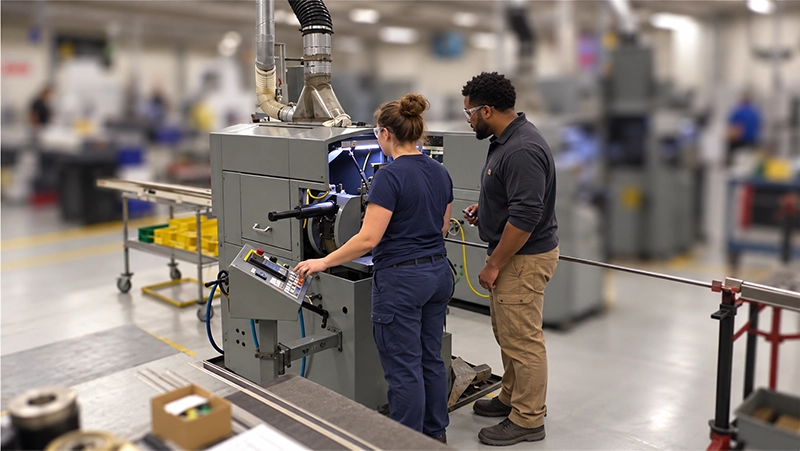
A global firm’s manufacturing division that produces advanced linear and rotary motion solutions needed to improve a critical upstream operation: Thread Rolling.
The operation cold-forms proprietary threads into six-foot rods, then machines them into customized lead screws that are used in stepper-motor linear actuators. With more than 60 unique threadforms, the thread-rolling operation supports the CNC production and feeds into almost 90% of assembled products. It affects much of the division’s manufacturing flow. Daniel Penn Associates (DPA) led a focused kaizen event to identify and test improvements.
The Challenges
Changeovers averaged 2.5 hours, and the average production rate was 90 feet per hour. These constraints created downtime, encouraged larger batches and higher inventory, and limited scheduling flexibility.
Video analysis of the changeover revealed preparation while equipment was stopped and excessive travel. Matching the thread-rolling dies involved adjustments that could take 20 minutes to two hours to dial in. Gathering materials, changing tooling, and preparing rods added more downtime. The opportunity: to change how work was prepared, organized, and performed.
Goals
The team established three measurable targets:
- Reduce average setup time from 150 minutes to 45 minutes.
- Increase average production speed by 20%, from 90 to 108 feet per hour.
- Increase projected annual output by 36.7%, from 229,000 to approximately 313,140 feet, using the existing thread rollers and floor space.
Maintaining safety and improving it wherever possible was mandatory.
Process
DPA facilitated a cross-functional team representing production, operations, and engineering. The approach combined lean training, direct observation, video analysis, workflow mapping, and hands-on trials.
The team applied Single Minute Exchange of Die (SMED) principles, eliminating wasteful activities and then separating internal tasks that require equipment to be down from external tasks that can be completed while it operates. Moving preparation outside the shutdown period became a central improvement strategy.
Participants generated 33 setup-reduction ideas and 12 additional productivity ideas. They tested proposed changes, recorded an improved setup, conducted speed trials, and developed follow-up actions.
Solutions
Prepare tooling before the machine stops. The team modeled and tested a changeover cart stocked with required tooling and materials. It planned storage locations for dies, bushings, blades, and test pieces around a new central kitting area where carts could be prepared before changeovers.
Eliminate repeated adjustments. Trials explored rotary matching to align the dies more efficiently. The team revised setup sheets to capture final settings for use on future changeovers, rather than repeatedly rediscovering successful adjustments. They brainstormed ideas to eliminate adjustments and planned for future development.
Increase speed. They ran speed trials using a single-factor designed experiment. These included rod inspections and checks for heat buildup. Testing identified acceptable higher speed settings but also exposed process limits for maintaining quality. The team plans further engineering and testing across materials, rod diameters, and thread leads. Approved changes will be documented on setup sheets as the subsequent trials are run and analyzed.
Address downtime beyond changeovers. The team developed solutions for several other sources of process downtime. A revised morning warm-up approach saved 6.5 minutes in a trial. Follow-up opportunities included transferring preventive maintenance to the maintenance department, evaluating chilling methods to shorten waits before quality measurements, and considering automated rod loading and unloading.
Outcomes/Improvements
A demonstrated 37-minute setup
The improved trial required 37 minutes of internal setup time, with another nine minutes of preparation performed externally. This beat the 45-minute target for that part. The time saved was attributable to staged tooling, reduced travel time, and fewer adjustments.
A projected 55.7% increase in annual output
The post-event assessment combined three improvement opportunities:
| Opportunities | Basis | Estimated Additional Annual Output |
|---|---|---|
| Faster Operation | Weighted average speed increase of 30%. | 48,000 feet |
| Shorter Setups | Estimated 95-minute reduction per setup across 203 annual setups, recovering approximately 321 hours. | 37,553 feet |
| Other Productivity Improvements | Estimated 359 hours annually from additional downtime reduction improvements. | 42,003 feet |
Together, the estimated annual output totaled 127,556 additional feet per year, a 55.7% increase over baseline, compared with the original 36.7% target. Converting these projections to annual production results depends on further validation and implementation.
A defined route to sustain progress
Next steps for the team will include completing the kitting area, continuing rotary-matching and speed trials, and updating part-specific setup sheets with matching documentation. This event gave the division both a demonstrated setup improvement and a quantified, workable plan for greater capacity. As the improvements are implemented, the company will benefit from smaller batches, more flexible scheduling, and better responsiveness to customer needs.
_______________________________
For more continuous improvement articles:
- How to Prepare for a Kaizen Event
- How to Tackle Overall Equipment Effectiveness
- Accountability is a System
- What’s holding you back from operational excellence?
- Hidden Capacity in the Curing Process
- The Power of Intentionality: How to Sustain Continuous Improvement to Maximize Efficiency
Where is downtime limiting your manufacturing capacity? Contact Daniel Penn Associates to discuss a focused kaizen event for your priority operation.